Microbe Atlas
17 bacteria, archaea, eukaryotes, and viruses. Tap for shape, size, habitat, and role.
Grow colonies, spread an epidemic, and evolve antibiotic resistance with your fingertips. KINRAKU turns microbiology into 14 hands-on simulations.
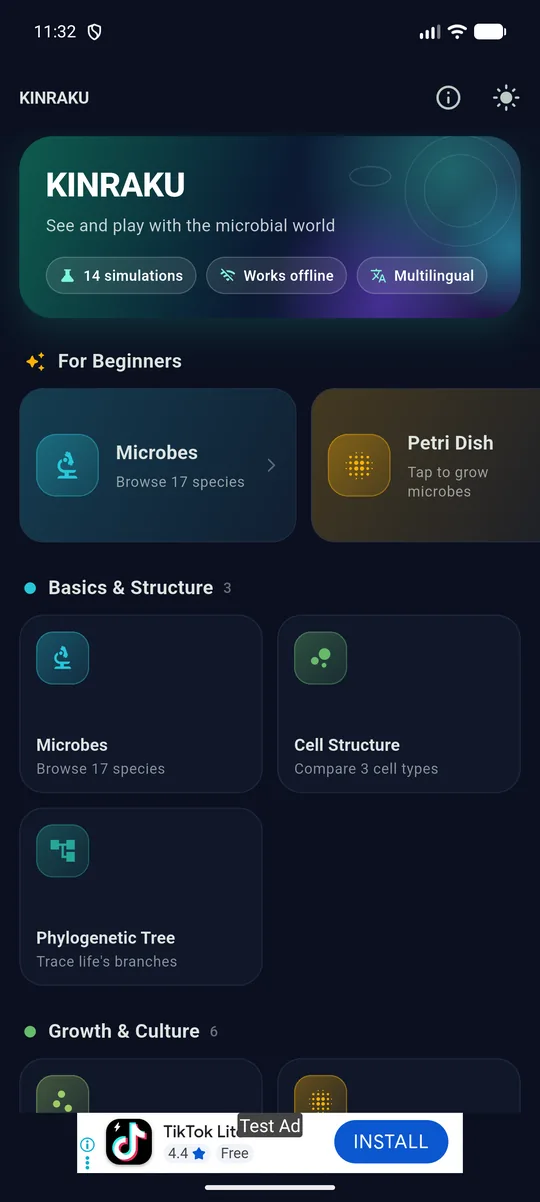
From the shape of a single cell to a nationwide epidemic — every mode comes with an easy explanation sheet.
17 bacteria, archaea, eukaryotes, and viruses. Tap for shape, size, habitat, and role.
Compare cross-sections of cells from all three domains of life.
From the last universal common ancestor to Bacteria, Archaea, and Eukarya.
Binary fission, budding, and sporulation — feel the power of exponential growth.
Tap to inoculate. Nutrients, temperature, and pH shape how colonies grow.
Attachment, matrix, maturation, and dispersal, driven by quorum sensing.
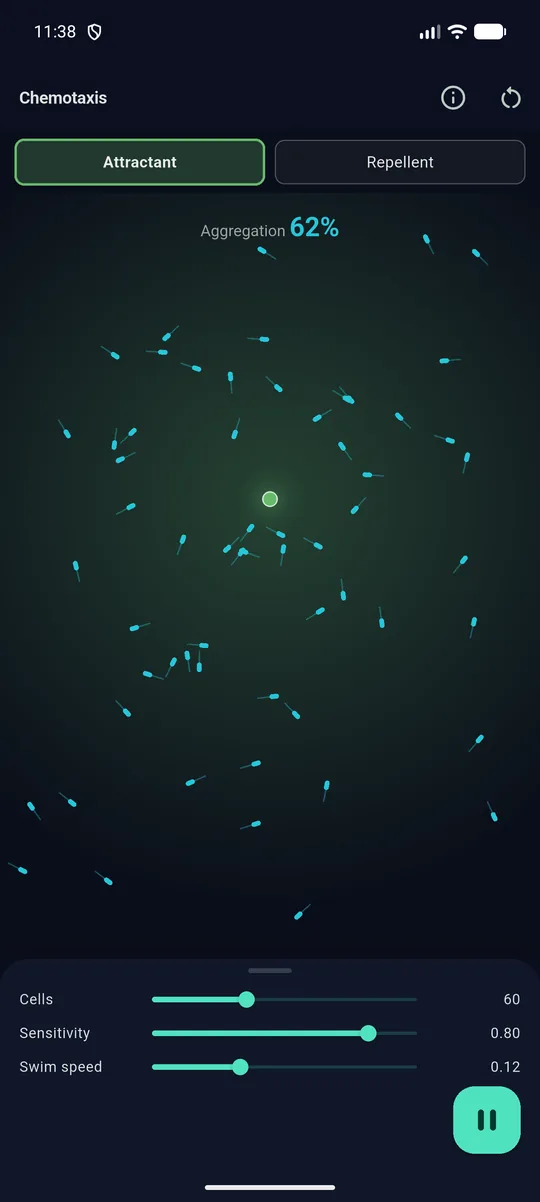
Run-and-tumble toward food and away from toxins. Drag the source around.
Lactic acid bacteria, yeast, and koji mold with live pH and CO₂.
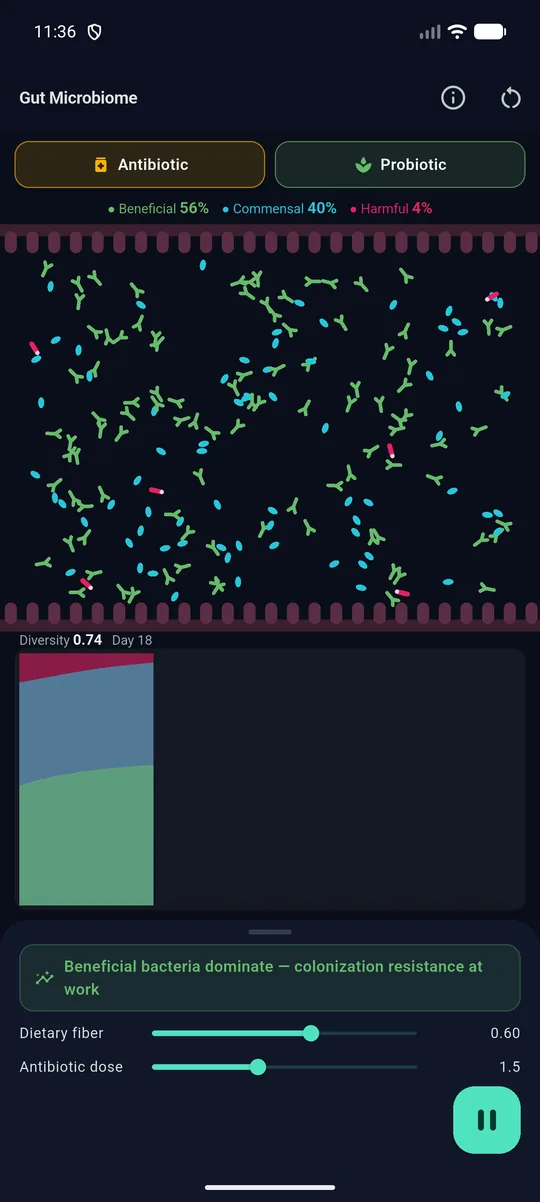
Beneficial vs. harmful bacteria. Try antibiotics, dietary fiber, and probiotics.
Hundreds of agents, a live epidemic curve, and R₀ in real time.
Travel between regions spreads the outbreak. Try lockdowns and vaccination.
Macrophages chase down and engulf invading pathogens.
Antibiotic pressure selects resistant mutants — evolution on fast-forward.
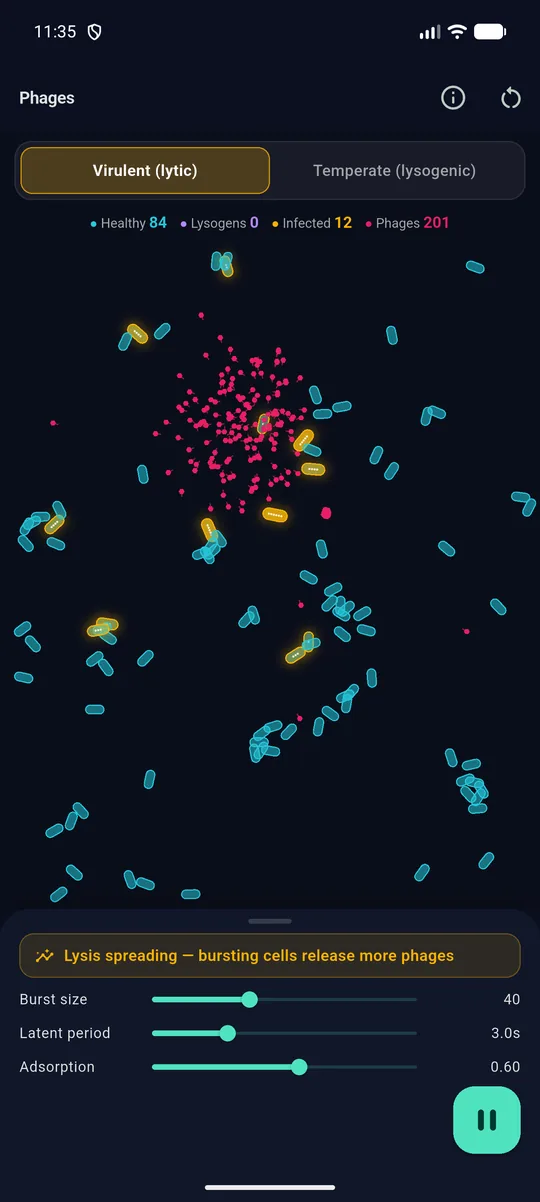
Viruses that infect bacteria through the lytic and lysogenic cycles.
Agent-based simulations make the ideas behind the equations intuitive.
Every mode has a sheet covering the key models: SIR, logistic growth, selection, and more.
All simulations run on your device. No account, no sign-up.
Available in many languages, with dark and light themes.
Swipe through the app.
Yes. KINRAKU is free to download and use. It is supported by a small banner ad at the bottom of the home screen.
iPhone and iPad with iOS 15.0 or later, and Android 7.0 (API 24) or later.
Yes. Every simulation runs on your device. An internet connection is only used to show ads.
Of course. It is free to use at schools, cram schools, universities, and for self-study.
They use simplified textbook models such as SIR, logistic growth, and natural selection. They are for learning and must not be used for medical or public-health decisions.

Free on the App Store and Google Play.